Designing an Outdoor Kitchen That Survives Austin Summers
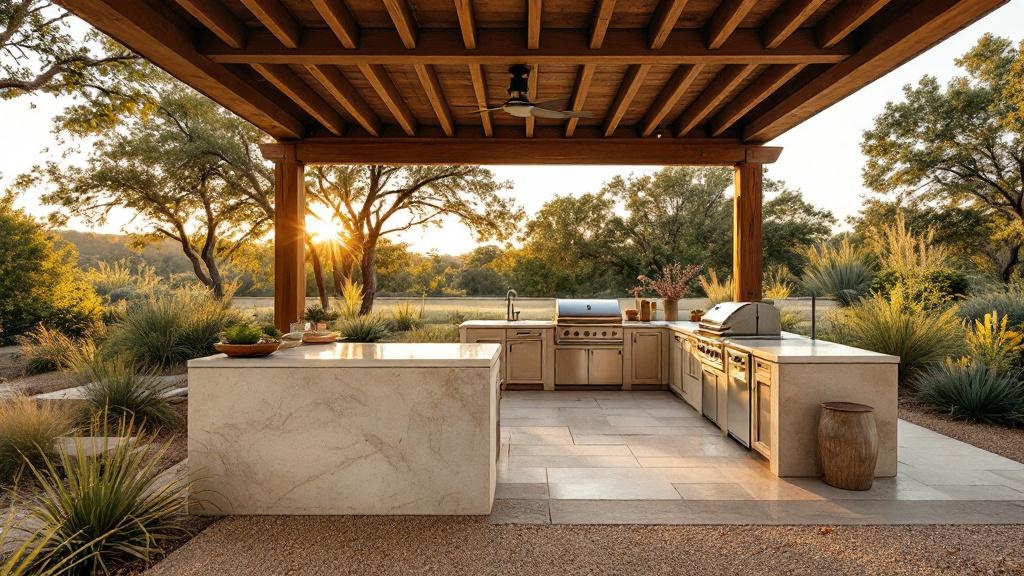
Most outdoor kitchens in Austin sit unused from mid-June through mid-September. The design failed to plan for the part of the year when the homeowner actually wants to be outside cooking at sundown. Here’s how we design outdoor kitchens that work in 100-degree heat — and what to avoid if you want one that gets used.
An outdoor kitchen is the most expensive single element in most landscape projects. A serious one runs $40k-$120k installed. The question isn’t whether you can afford a built-in grill — most clients can. The question is whether the design accounts for the actual conditions in Austin between Memorial Day and Labor Day, when the kitchen needs to perform, and what design choices either save or sink the project.
The problem the showroom doesn’t show you.
Walk into a kitchen showroom in March and you’ll see beautiful renderings of polished granite counters under cedar pergolas in dappled afternoon sun. None of that imagery is shot at 4pm in August. At 4pm in August on a south-facing limestone patio in Westlake, the surface temperature of the polished granite hits 145 degrees and the air temperature in the “kitchen zone” sits at 104. You can’t touch the counter. You can’t stand under the pergola without shade. The grill works fine, but you don’t.
Most outdoor kitchens we get called to fix were designed without a real shade strategy, oriented the wrong way to the afternoon sun, or specified materials that weren’t going to handle Texas heat. The fix is rarely simple — usually it requires extending the structure, changing the orientation, or replacing the counter material entirely.
If you can’t comfortably stand at your outdoor kitchen at 6pm on August 15th, the kitchen is wrong. Everything else is detail.
The four design rules.
Every outdoor kitchen we build follows the same four rules. Skip any one of them and the kitchen sits unused through summer.
Rule one: shade is the entire design. Not “shade is part of the design.” Shade IS the design. Everything else — grill placement, counter material, lighting — happens inside the shade structure. We orient kitchens to maximize afternoon shade (typically east-facing under a deep pergola or pavilion), and we shade the entire workspace, not just the cook position. A grill in the sun and a counter in shade is half a kitchen.
Rule two: airflow. The pergola or pavilion needs to allow heat to escape upward. A fully-roofed pavilion with no ventilation traps grill heat under the structure and creates a sweat box. We use slatted roofs, louvered pergolas, or vented pavilions with cedar slats that move enough air to keep the under-structure 10-15 degrees cooler than the surrounding patio.
Rule three: counter materials chosen for heat. Polished granite hits 140+ degrees in direct sun and stays hot for hours after sundown. Hand-cut limestone, honed quartzite, sealed travertine, and concrete with a matte sealer all stay within hand-touchable range even in full sun. We never use polished dark stones on an outdoor counter in Austin. Hand-cut Hill Country limestone is our default — it’s gorgeous, doesn’t cook your forearm when you lean on it, and matches the rest of our work.
Rule four: a cool zone within reach. The cook needs cold beverages, the guests need something to do other than watch the cook. Build in a refrigerated drawer or beverage cooler within reach of the work surface. Don’t make people walk to the house. This single detail is what turns the outdoor kitchen from a project showpiece into a thing that gets used three nights a week.
Orientation matters more than you think.
The right orientation for an Austin outdoor kitchen is east-facing, set against a south or west wall, under a deep overhang. That puts the cook out of the afternoon sun while still keeping the long-light golden-hour view available to guests sitting at the bar.
The wrong orientation is west-facing into the sunset, which is what most builders default to because “people want to watch the sunset while they grill.” They do, in theory. In practice, they wear sunglasses, squint, and never come outside until 8:30. Set the seating so guests can see the sunset, and set the cook position so they don’t have to.
The pergola structure.
A pergola over an outdoor kitchen has to do four things: provide deep shade, allow heat venting, support an overhead fan, and look architectural rather than utilitarian. Our default specification:
- Cedar or thermally-modified ash members, 6×6 posts, 4×10 beams, 2×4 slats on 4-inch centers
- Steel-plate post anchors set into the limestone or concrete substructure
- One commercial-grade ceiling fan per 100 sq ft of covered area
- Integrated downlight track for evening cooking
- 10-12 ft ceiling height (don’t go lower — the kitchen feels claustrophobic)
The difference between a pergola that costs $18k and one that costs $42k is the structural detailing, the post-anchor work, and the materials. The cheap version sags within five years. The right version still looks new in year fifteen. We’ve written more about pergola design here if you want to go deeper.
The appliances.
This is where homeowners typically spend the most time deciding and where the decisions matter least. The grill brand isn’t going to determine whether your kitchen gets used — the shade and counter material will. That said, here’s the short version:
Grill: 36″ or 42″ gas grill with infrared rotisserie burner. Lynx, Hestan, or DCS for premium; Bull or Blaze for mid-range. Skip the smaller 30″ units — they’re undersized for the space and don’t have a meaningful margin for entertaining.
Side burner: Useful if you actually cook sides outside. Most people don’t and use it once a year. We skip it on 60% of projects.
Pizza oven: Either go all-in with a wood-fired Italian (Forno Bravo, Mugnaini) installed properly with a chimney and proper draft, or skip it. The bolt-on countertop pizza inserts don’t perform.
Smoker: Texas. You want one. Built-in offset or a pellet smoker that vents to outside air. Don’t put it under the pergola — smokers need ventilation.
Refrigeration: Two compartments minimum — one for beverages, one for protein. Stainless steel undercounter units rated for outdoor use. Don’t use indoor fridges outside; they fail within two years.
Sink + water: Yes if you have an existing water and waste line within 30 feet. No if you’d have to trench across the yard. The sink gets used less than people think.
Lighting strategy.
Outdoor kitchen lighting is layered like indoor lighting: ambient, task, and accent.
Ambient comes from the ceiling fan light kit and string lights along the pergola edges. Task lighting is under-counter LED strips and downlight track at the grill and prep zone — bright enough to read a thermometer at 9pm. Accent lighting is uplights on the structure posts and downlights into the counter from above for atmosphere.
The mistake we see most is overcooking the task light. A 4000K LED tape under every counter edge looks like a hospital. We use 2700K-3000K everywhere, dimmed independently, with the task light kept at 50% by default. Our landscape lighting philosophy goes into this in more detail.
The cost structure (no surprises).
A real outdoor kitchen in Austin is between $45k and $90k for the build, not including the pergola, lighting, and surrounding hardscape. Total project cost — kitchen + structure + adjacent patio — typically lands $80k-$160k. Here’s where that money goes:
- Pergola or pavilion: $18k-$45k
- Counter masonry + finish: $14k-$28k
- Appliances: $10k-$30k depending on package
- Gas, water, electrical rough-ins: $6k-$12k
- Lighting + fan: $3k-$7k
- Permits + engineering: $2k-$5k
- Surrounding hardscape + plantings: $20k-$60k
Anyone quoting an outdoor kitchen at $25k installed in Austin is cutting corners that you’ll notice within two summers — usually the pergola structure or the substrate beneath the counter.
The thing nobody tells you.
The single best money you’ll spend on an outdoor kitchen project is on the pergola fan. A commercial-grade 60-inch outdoor ceiling fan running on high drops the felt temperature of the cook zone by 8-12 degrees and turns July from “barely usable” into “comfortable.” It’s a $400-700 item that determines whether the entire $80k kitchen gets used.
The second best money is on the shade design. The third is the counter material. Everything after that is preference. Get those three right and the kitchen will be the most-used room in your house, six months of the year.
Designing an outdoor kitchen for an Austin yard?
We design and build outdoor kitchens that work in 100-degree heat — shade-first, oriented for actual use, with materials that don’t cook your forearms.
Request a site visit