Why Your Austin Lawn Keeps Dying — And What to Plant Instead
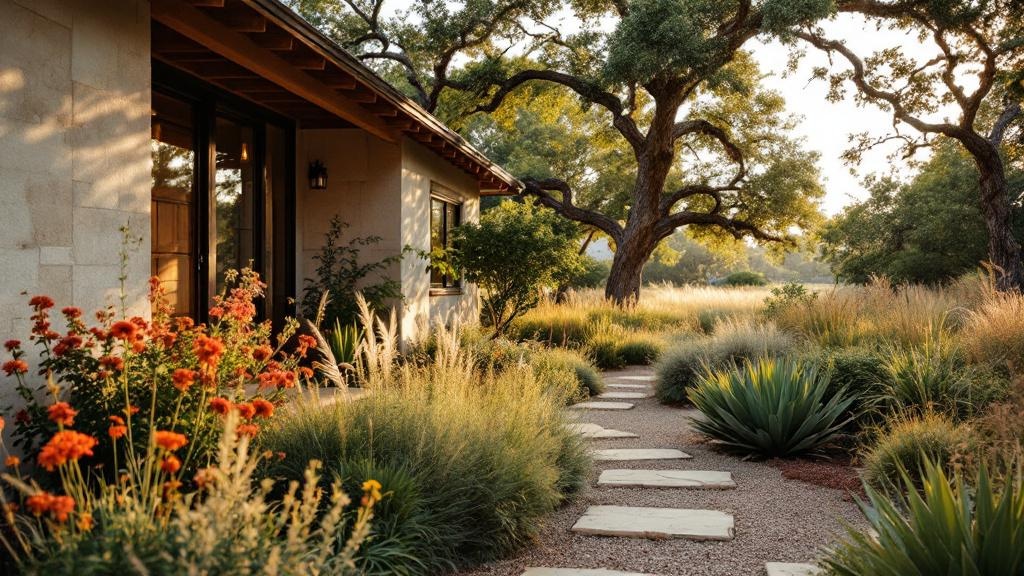
Your lawn isn’t dying because you’re bad at lawn care. It’s dying because it doesn’t belong in Austin. Fescue, ryegrass, and even St. Augustine were bred for somewhere wetter, milder, and cooler. Keeping them alive here costs more water, more chemicals, and more weekend hours than they’re worth — and the result, in August, is still a brown patch with a sad sprinkler.
This is not an indictment of your gardening. It’s an indictment of the assumption that every yard needs grass. If you take a step back and ask what a lawn is actually for — a place for kids to play, a soft ground plane that reads as “tended” from the street, a green frame for the rest of the planting — there are better answers in Austin than turf.
What you’re actually fighting against.
Austin gets roughly 34 inches of rain a year, but it falls in three or four large dumps and a hundred days of bone-dry sunshine. Soil ranges from thin alkaline limestone west of MoPac to heavy expansive clay east of I-35. Summer highs hit 100 for fifty days in a normal year, hotter in a bad one. UV index runs in the 9-11 range from May through September.
The cool-season grasses (fescue, ryegrass, bluegrass) were bred for the Pacific Northwest, the Midwest, and the East Coast. They go dormant or die at sustained 90+ heat. The warm-season grasses (St. Augustine, Bermuda, zoysia) handle heat better, but they need 1.5 to 2 inches of water a week to stay green in summer — which means running irrigation or watching it brown out. Either way, you lose.
The amount of water it takes to keep a traditional Austin lawn green in August is the same amount it takes to keep a 1,500 sq ft native garden alive for an entire year.
The five things that actually kill your lawn.
Before we get to alternatives, here’s why what you have is failing — in order of how often we see it.
Shallow watering. Most homeowners water 15 minutes three times a week. That wets the top inch of soil, which evaporates by the next afternoon. Roots stay shallow. The first week of drought kills the plant. The fix — if you must water a lawn — is to water deep and infrequent: an hour, once a week, at dawn.
Heat reflection from hardscape. A south-facing strip of grass next to a concrete driveway sees ambient temperatures 15 degrees hotter than the rest of the yard. No turf grass survives that without daily water. Pull the lawn back from hardscape and replace with a heat-tolerant groundcover or gravel.
Foot traffic on wet soil. Walking on wet St. Augustine compacts the soil, kills the roots, and creates brown channels exactly where you walk. Either pour a flagstone path or accept that the lawn dies on your dog’s routes.
The wrong species for your microclimate. The grass installed under your live oak isn’t getting enough sun to photosynthesize. The grass on the south-facing slope is getting too much. Most yards have three or four microclimates. Most have one species of turf.
Aspirational mowing height. Mowing St. Augustine below 3.5 inches in Austin is a death sentence. Bermuda you can scalp to 1.5 inches if you’re willing to water it daily. The mowing height most people use comes from looking at golf-course turf and trying to recreate it. Don’t.
What to plant instead.
The right replacement depends on what you actually do in the lawn area. Walk it for a week and watch.
For kids and dogs — a real “playable” lawn. Use buffalograss. It’s native to the Hill Country, takes one-third the water of St. Augustine, mows to 2-3 inches, and goes dormant (not dead) in deep drought. It’s not as soft underfoot as St. Augustine, but it handles play without irrigation. Install in spring after soil temps hit 70. Expect it to look thin for a year, then fill in.
For the visual lawn area that no one walks on. Skip the grass entirely. Use a groundcover sweep — silver ponyfoot, horseherb, or frogfruit. These spread densely, take heat, take drought after the first year, and read as a soft green ground plane from any distance. They’re not for foot traffic, but they’re for everything else.
For the unused side yard or back corner. Plant a small native meadow. Mexican feather grass, gulf muhly, little bluestem, sideoats grama, and lemon mint will give you a four-foot-tall, color-shifting meadow that looks intentional and asks nothing of you after year one. We’ve installed dozens of these. The maintenance is a single February mow.
For the slope. Slopes are where lawns fail fastest and erode worst. Replace with native shrubs (Texas sage, autumn sage, agarita), perennials, and a granite mulch. Within two years it’s a maintenance-free hillside.
The transition — how it actually works.
Going from a lawn-heavy yard to a native landscape doesn’t have to happen in a single weekend. The way we do it on most projects is in three phases.
Phase one (fall): kill the lawn where you want it gone. Sheet-mulch with cardboard and 4 inches of mulch. Don’t till — that brings up dormant weed seeds. Don’t use chemical herbicide if you can avoid it. By spring, the lawn is dead and the soil underneath is improved.
Phase two (winter through spring): grade and plan. Get the drainage and grading right while the area is bare. This is the only chance you’ll have to move soil without working around plantings. Plan paths. Get edge restraints in.
Phase three (next fall): plant. Plant the trees, shrubs, perennials, and grasses per the native garden plan. Within two growing seasons, the lawn area is unrecognizable, and you’ve cut your water bill by 60-80%.
What you’ll be told (and why most of it is wrong).
Talk about removing a lawn in Austin and you’ll get pushback. Here’s the common stuff and the actual answer.
“It’ll look unkempt.” Only if it’s designed unkempt. A native landscape with clear edges, intentional grouping, and a defined path reads as more polished than a struggling lawn. The trick is intentional design, not absence of design.
“Property values will drop.” Austin real-estate data does not bear this out. Drought-tolerant landscapes have appreciated faster than turf-heavy yards in the last decade, partly because buyers are aware of water costs and ongoing maintenance.
“HOAs will fine me.” Texas Property Code § 202.007 explicitly prevents HOAs from prohibiting drought-tolerant landscaping. Most HOAs in Austin now have explicit native-plant provisions. Read your covenant.
“It’s expensive.” The installation costs more than reseeding a lawn, yes. But the lifetime cost — water, fertilizer, mowing, replacement — is dramatically lower. Most native installs pay back in 3-5 years on water alone.
The harder thing to hear.
The honest answer is that you don’t need to keep working this hard. The lawn you’ve been fighting is dying because the climate has decided. The question is whether you’d rather keep losing the fight every August or change what you’re fighting for.
For most of our clients, the moment they stop watering a lawn for the first time and the yard still looks beautiful in October is a kind of weight off. The water bill drops. The weekend opens up. The garden gets more interesting, not less.
Ready to stop fighting the lawn?
We design and install native landscapes for Austin yards that look better than the lawn ever did — and ask far less of you in return.
Request a site visit