What “Native by Default” Actually Means — A Greenline Field Guide
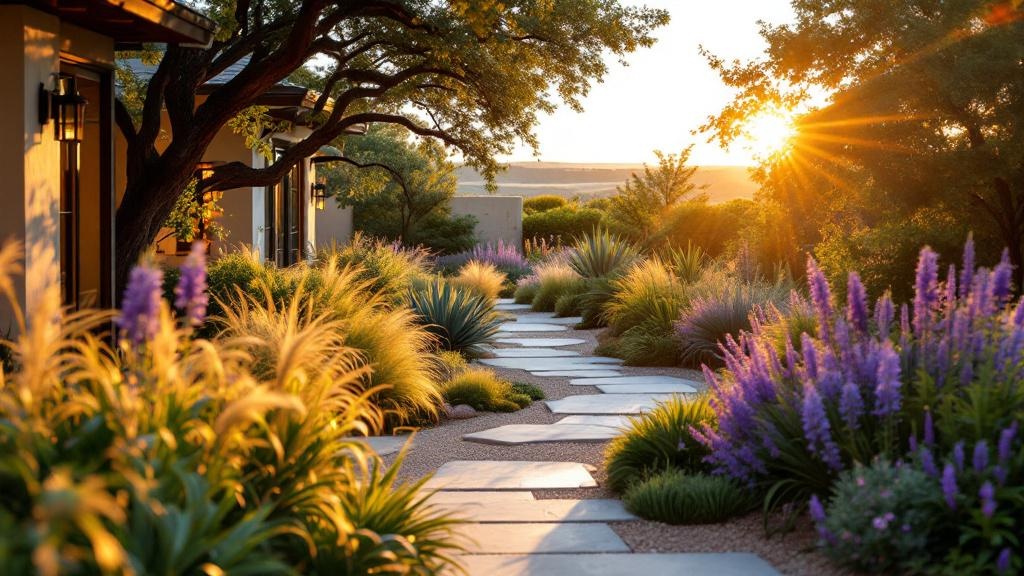
We say “native by default” on every project, on every site visit, and on the homepage. It’s the first of our three brand pillars, and it shapes every plant decision we make. But it’s also a phrase that gets misused by every nursery and landscape company in Austin. Here’s what it actually means in practice — and what makes a plant “native enough” for our designs.
Every Austin homeowner has heard the word “native.” Most have a vague sense that it’s good. Almost none could name twenty native Central Texas plants on a quiz. That’s not a criticism — the plant world is huge and the nursery industry is invested in keeping the distinction blurry, because non-native plants are cheaper to grow and easier to source. “Native by default” is our line in the sand: if there’s a native option that works, we use it. Period.
What “native” actually means.
A native plant, in our practice, is one that occurred in the Texas Hill Country or Edwards Plateau ecoregion before European settlement. That definition has hard edges and soft edges. The hard edges are clear: live oak, cedar elm, Texas sage, Texas mountain laurel, Mexican feather grass, blackfoot daisy, blue mistflower, gulf muhly, four-nerve daisy, salvia greggii, agarita — all unquestionably native.
The soft edges are the question. Is salvia farinacea (mealy blue sage), which is native to the Plateau but is now sold in cultivated varieties, still “native”? Is agave americana, which is from northern Mexico but has been growing in Central Texas for 300+ years, native? What about Mexican plum, which is native to the Rio Grande Valley and has naturalized here?
Our working answer: a plant is “native enough” if it (a) belonged to the broader Central Texas / northern Mexico ecological region pre-1700, (b) does not require irrigation past the first establishment year, and (c) provides ecological value (pollinator forage, bird seed, native insect host plant) without invasive risk. By that test, mealy blue sage, agave americana, and Mexican plum all pass. Pampas grass, nandina, and Bradford pear all fail — they’re sold as ornamentals everywhere, but they have no ecological function here and several have invasive potential.
The three reasons we lead with native.
This isn’t a moral position — it’s a design and engineering position. Three reasons.
Water performance. A native garden in Austin uses roughly one-tenth the supplemental water of an equivalent St. Augustine lawn or a bedding-plant garden. After the first establishment year, most natives don’t need supplemental water at all in a normal rainfall year. In a drought year, they slow growth, get drought-stress patina, then recover. They don’t die.
Ecological value. Native plants are co-evolved with native insects, birds, and pollinators. Monarch caterpillars eat exclusively milkweed. Black swallowtails eat parsley-family natives. Native bees pollinate native flowers in synchronized cycles with native bloom timing. A non-native garden looks pretty but functions as an ecological dead zone — pollinators visit and find nothing they can use. A native garden is alive.
Aesthetic regionalism. A native garden looks like the place it’s sitting in. That’s harder to overstate. A St. Augustine lawn with crape myrtles and Mexican petunias could be in Florida, Georgia, or Louisiana. It has no regional identity. A Hill Country native garden — Mexican feather grass, agave, limestone, live oak, gulf muhly — could only be in Central Texas. That visual coherence is what makes Hill Country properties read as places, not as generic landscaping.
A St. Augustine lawn with crape myrtles could be in Florida. A native Hill Country garden could only be here. That’s the entire argument.
What “native by default” doesn’t mean.
It doesn’t mean “100% native.” We do specify non-native plants in specific situations, and we’re transparent about when and why.
It doesn’t mean wild or unkempt. The best native gardens are highly designed — clear edges, intentional plant grouping, defined ground planes, and seasonal interest engineered through bloom timing. Wildness in the wrong context reads as neglect. Our gardens are wild in the right context (a meadow zone) and tightly composed everywhere else.
It doesn’t mean cheap. Native plants from a quality grower (Native American Seed, Patty Leander’s, Greenbelt Native Restoration) cost the same or more than non-natives. They take longer to grow to mature size in the nursery and they have to be harvested from limited regional stock.
It doesn’t mean low-maintenance forever. Native gardens still need editing — invasives have to be pulled, dominant species have to be cut back, and certain plants need to be rotated as they age. The maintenance is different from a lawn, not absent.
The exceptions we make.
We specify non-native plants in three situations.
Edible production. If a client wants a vegetable garden, herb garden, or fruit orchard, we obviously use non-native cultivars — tomatoes, peppers, Mediterranean herbs, peaches, figs. These go in dedicated zones that we design and locate intentionally, away from the structural native plantings.
Functional ornamentals with high ecological value. A few non-natives provide enough pollinator forage to earn a place in our designs. Crape myrtles are a complicated one — non-native, but heat-tolerant and bee-attractive in bloom season. We use them sparingly, almost always cultivars with controlled habit. Salvia microphylla and salvia ‘mystic spires’ are non-natives that pollinators love, drought-handle well, and integrate with native salvias visually.
Specific aesthetic needs. A client wants a formal European look or a specific landscape mood that natives can’t deliver. We’ll do this if asked, but we always present the native alternative first and explain the trade-offs.
The plants we won’t use, no matter the request.
Some plants we refuse to specify for ecological reasons. The shortlist of the worst offenders in Central Texas:
- Pampas grass — invasive, displaces native grasses, fire hazard
- Bradford pear — invasive, brittle wood, fails within fifteen years
- Nandina (heavenly bamboo) — invasive, berries are toxic to cedar waxwings
- Chinaberry — invasive, displaces native trees, allelopathic
- Glossy privet (Chinese privet) — invasive, smothers understory
- Bermuda grass on slopes — invasive, requires constant chemical input
- Heavenly bamboo — see nandina, same plant
We’ve had clients ask for some of these because they saw them in a model home. The honest answer is: we won’t install them. There are better-looking, lower-maintenance, locally-appropriate alternatives for every one of them. The model home installer was using what was cheap and available, not what was right.
How “native by default” shows up in a specific project.
Let me walk through a real example. A client in Tarrytown asked for a “low-maintenance ornamental garden” in their front yard, with a small lawn for the dog. Their initial mood board: hydrangeas, English boxwoods, Japanese maples, fescue lawn.
Here’s what we built instead:
- The “lawn”: Buffalograss for the dog area (one-third water of fescue, native, no irrigation after year one). 200 sq ft, defined by limestone edging.
- The “hydrangeas”: Texas mountain laurel and salvia ‘Mystic Spires’ (mostly native, blooms three seasons, fragrant, pollinator-rich).
- The “boxwoods”: Native evergreen sumac and yaupon holly cones, sheared into the same architectural shape as boxwood, with zero pest pressure and one-quarter the water.
- The “Japanese maple”: A Mexican buckeye and a Texas redbud, both with stunning spring bloom and fall color, both natives.
The client got the visual mood they wanted — a refined front garden with structured architectural plants and seasonal color. They didn’t get hydrangeas, but they got a garden that thrives without irrigation after the establishment year. Year three, the garden looked better than the Pinterest reference they’d shown us. They didn’t miss the hydrangeas.
The hardest part.
The hardest part of “native by default” isn’t the plant choices. It’s helping clients see past what they’ve been told a “nice yard” looks like. Most Austin homeowners grew up looking at Eastern or Midwestern gardens, or Southern California gardens, and they bring those references to their own properties. The work of designing native is partly a design exercise and partly a conversation about what regional aesthetics actually mean.
By the time a project is six months out from install, that conversation has usually flipped. Clients who started skeptical of native are usually the ones who, two years later, point out that their neighbors’ “traditional” yards look out of place. Once you see Hill Country aesthetics — once you really see them — generic landscape work starts to feel borrowed from somewhere else.
That’s the long version of “native by default.” It’s not a slogan. It’s a design discipline, an ecological commitment, and a regional aesthetic, all at once. And it’s why our work looks the way it does.
Want a landscape that belongs in Austin?
We design native-first gardens for Hill Country properties. Every plant decision starts with what works here, not what looks good on Pinterest.
Request a site visit