Limestone vs. Flagstone vs. Pavers: Hardscape Materials Ranked for Texas Heat
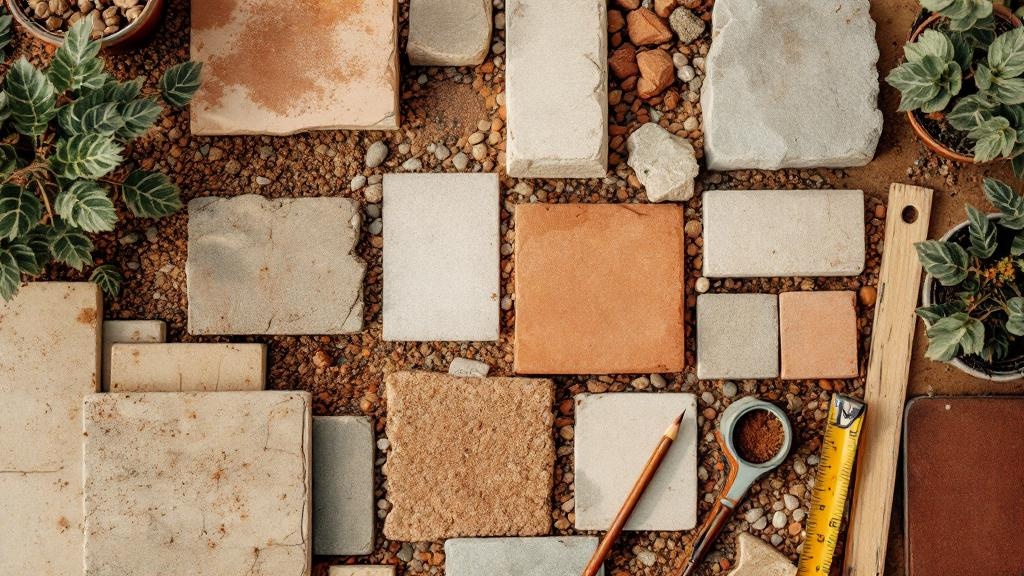
Three materials. Three behaviors in Texas heat. We’ve installed all of them on Austin projects, repaired all of them on other people’s projects, and we have strong opinions about when each one is the right call. This is a frank ranking — the long version of the conversation we have with every client during a site visit.
Hardscape is the most expensive part of a landscape project and the part most homeowners get wrong. A patio you walk on every day for twenty years is not a place to save $4 a square foot. The decision between limestone, flagstone, and pavers usually comes down to budget, aesthetics, and how the material behaves over a decade of Austin sun, rain, and freeze-thaw. Here’s how we think about it.
Hill Country limestone — our default.
We use hand-cut Texas limestone on roughly 80% of our hardscape projects. It’s quarried within 80 miles of Austin (Lueders, Sisterdale, Cordova Cream), which makes it climate-matched to our heat cycling, our soil chemistry, and the visual context of the Hill Country. It develops a patina over five years that improves the surface rather than degrading it.
What it does well: Holds shape through expansive clay heaving. Handles 100+ degree surface temperatures without delaminating. Develops a mossy joint character in shaded areas that looks intentional. Reads as architecturally grounded — it looks like it came from the place it’s sitting in.
Where it struggles: Cost. Hand-cut limestone runs $35-50 per square foot installed, depending on cut quality and pattern complexity. Tumbled or saw-cut is cheaper ($22-35) but loses some of the character. It’s also heavy to work with, which means slower installs and higher labor cost.
When we specify it: Patios visible from the house, courtyards that anchor the design, walkways from front gate to door, and any wet location (pool surrounds, water features) where the textured surface adds slip resistance. Most clients pick it once they see it on a site visit. It’s the right answer for most Austin yards.
Hand-cut Texas limestone is the material that looks better in year ten than the day we install it. Almost nothing else does.
Oklahoma flagstone — the runner-up.
Flagstone from Oklahoma quarries (Buff, Chocolate, Tumbleweed colors) is the second most-used material in Austin landscape design. It’s less expensive than Texas limestone, comes in larger and more irregular pieces, and reads as more rustic.
What it does well: Visual texture and irregular shapes create a softer, more cottage-garden feel. Less expensive than limestone — $20-35 per square foot installed depending on thickness. Available in a range of warm tones that complement limestone wall accents.
Where it struggles: Delaminates over 10-15 years if not sealed and installed on a proper base. We’ve torn out a lot of failed flagstone in Austin where the original install was a single layer set in DG with no compacted base. The sandstone composition is softer than limestone and more porous, which means staining issues from oak tannins and grilling oil.
When we specify it: Informal courtyards, side gates, transitional paths from limestone patios out to gardens, fire-pit surrounds where the rougher texture adds visual interest. We almost never use it as a main patio — limestone outperforms it on the surfaces you actually live on.
Manufactured concrete pavers — last resort.
Pavers (Belgard, Pavestone, etc.) are the lowest-cost option and the most-installed hardscape in Austin tract construction. We use them rarely, and only in specific situations.
What they do well: Predictable cost — $14-22 per square foot installed. Uniform shapes that install fast. Engineered locking patterns that resist movement if installed correctly. Available in any color and aspect ratio you want.
Where they struggle: Color fading. Most concrete paver colors lose 30-50% of their saturation by year seven. The exception is integrally colored, double-cast pavers, which cost almost as much as flagstone. Surface efflorescence (white salt deposits) is common in the first three years and almost impossible to remove. They never develop the patina that natural stone does — they just look older.
When we specify them: Hidden utility areas (HVAC pads, side-of-house dog runs), driveways where the cost differential with limestone is significant, and specific architectural styles (modernist) where the geometric precision of pavers is the design intent. Almost never on a primary patio.
The thing most installers get wrong: the base.
Whichever material you choose, the base under it is what determines whether it lasts. Austin’s expansive clay soils heave 1-2 inches between wet and dry seasons. A 2-inch base of compacted sand on undisturbed clay will crack within three years, no matter how expensive the stone on top.
The right base in Austin is 6-8 inches of compacted #57 limestone road base on a separated geotextile fabric over excavated and recompacted subgrade. That’s the boring part nobody talks about, and it’s the part that determines whether the patio is still flat in year fifteen.
Every Greenline hardscape install starts with a base specification that exceeds residential standard. It’s not glamorous. It’s why our patios don’t crack.
Edge restraint — the second thing most installers get wrong.
Whatever you build, the edges have to be restrained or the whole assembly walks. Three options:
- Set-stone edge band — a soldier course of larger, mortared-in pieces around the perimeter. The most permanent and best-looking solution. Most expensive.
- Cor-Ten steel edging — quarter-inch weathering steel set into a trench. Develops a rust patina that suits the Hill Country aesthetic. Adds $8-15 per linear foot.
- Concrete curb — poured-in-place 4-inch curb buried below grade. Cheapest, least visible, used on driveways and large utility areas.
Without one of these, decomposed granite, gravel, and dry-laid pavers all migrate. We’ve seen DG paths “disappear” within two years on neighbor projects that skipped the edge. The cost of the edge restraint is 5-8% of the project. Skipping it is the most expensive cheap decision in residential hardscape.
What about decomposed granite (DG)?
DG isn’t really a competitor to the three above — it’s a different category. We use it on informal paths, shaded courtyards under oak canopies, and as a transition material between patios and gardens. Stabilized DG (with a polymer binder) holds up to traffic, runs $6-10 per square foot, and develops a beautiful Hill Country golden patina over time.
Don’t use it next to grass (the grass invades), don’t use it on slopes greater than 3% (it migrates downhill), and don’t skip the edge restraint. Used in the right context, it’s one of the most charming materials available in Austin.
How to choose for your specific yard.
Walk the yard and answer four questions:
- Where will the surface be visible from inside the house? That’s where the budget goes. Use limestone or premium flagstone where the eye lands.
- What’s the substrate? West-of-MoPac yards on limestone bedrock can use shallower bases. East-of-I-35 clay yards need deep bases. The geology determines cost.
- How wet does it get? If the area pools after rain, you have a drainage problem that needs solving before any hardscape goes in.
- What does the house look like? Limestone for traditional and Hill Country modern. Pavers for strict modernist. Flagstone for cottage and craftsman. Material should match the architecture, not fight it.
The short ranking.
For an Austin homeowner who wants something that will outlast the install — and who’s not building to a strict budget cap — the order is:
- Hand-cut Hill Country limestone, set on a 6-8 inch compacted base, with set-stone or Cor-Ten edging. Twenty-year material. Looks better in year ten than year one.
- Premium Oklahoma flagstone, set on the same base, sealed every 5-7 years.
- Stabilized decomposed granite for paths and informal areas.
- Manufactured concrete pavers — only for utility areas or when the design demands geometric precision.
For most yards, the answer is some combination of items 1 and 3 — limestone on the surfaces you live on, DG on the connecting paths. That’s the formula in 70% of our portfolio.
Planning a hardscape project?
We’ve installed every material on this list, and we’ll tell you which one is right for your yard. Site visit, soil read, drainage assessment, and a frank budget conversation.
Request a site visit