The Drainage Mistakes That Will Ruin Your Austin Yard
Austin gets 25 to 35 inches of rain in a normal year, on top of expansive clay soil that swells and shrinks by inches between seasons. Almost every drainage failure we see on a residential project was foreseeable on the day of the install. Here are the mistakes we encounter most, what they cost to fix, and what a properly-drained Austin yard actually looks like.
Drainage is the buried part of every landscape — invisible when it works, catastrophic when it doesn’t. A landscape that handles a 5-inch overnight rain is the result of decisions made at the grading stage, not improvisations after the storm. The mistakes below cost between $4k and $40k to fix depending on severity. Almost all of them are cheaper to do right the first time.
Mistake one: flat-grading the yard.
A “level” yard is the most common ask we get on initial calls, and it’s almost always the wrong answer. Water needs somewhere to go. A truly level yard sends water in random directions — often back toward the foundation — and creates pooling everywhere it finds a low spot.
The right grading is a deliberate slope: 2% minimum away from the house in all directions, with a clear path to a designated drain or absorption zone. That’s about 1 inch of fall over 4 feet — barely noticeable underfoot, but enough to direct water predictably. On clay-heavy lots east of I-35, we sometimes go to 3% near the foundation.
What it costs to fix: Regrading a quarter-acre lot after planting is in is $6k-$18k. Doing it right at the start of the install is rolled into the existing scope. Don’t accept “we’ll address drainage at the end” from any installer.
Mistake two: no path off the patio.
A new patio creates an impervious surface. Water that used to soak into the lawn now has to go somewhere else. Most installers leave the patio as a dam, with no swale, drain, or slope to carry water away. Within two storms, the area below the patio is a mud trap and the patio is undermined at the downhill edge.
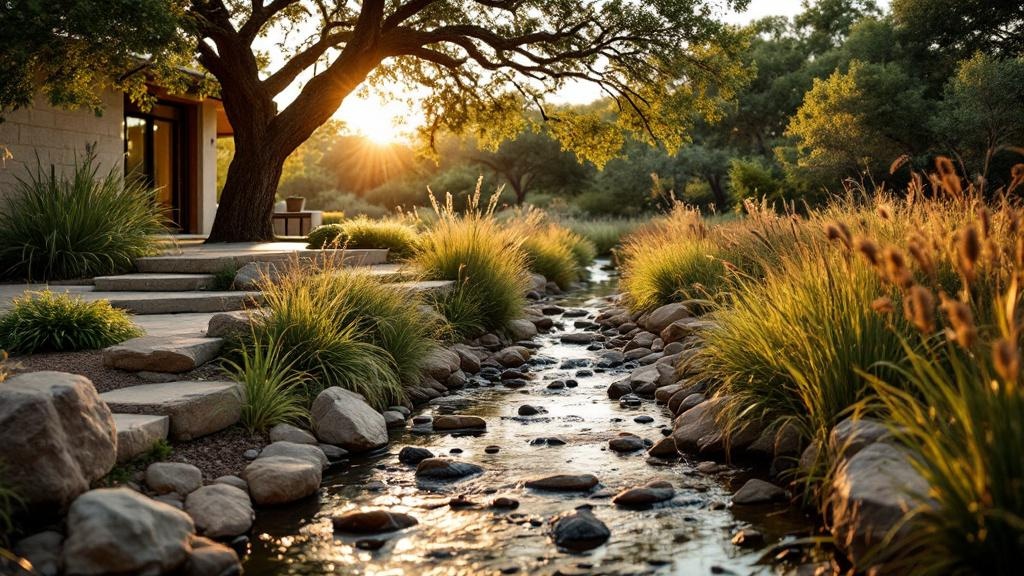
The fix is built into every Greenline hardscape install: a 1.5-2% slope across the patio surface, edge restraint at the downhill side, and either a French drain or a naturalistic dry creek bed to receive the runoff. We design these as features, not afterthoughts — a limestone swale with river-rock bottom and native sedges is one of the best-looking elements in any Hill Country yard.
Mistake three: gutter downspouts that dump into the bed.
Most Austin homes have downspouts that discharge directly into a foundation bed, six inches from the wall. Every rainstorm dumps the equivalent of a fire-hose blast into the soil against the house. This destroys plantings, saturates foundations, and accelerates the expansive-clay heave cycle that cracks slabs.
The fix is buried 4-inch PVC pipe running from each downspout to a daylight outlet at least 15 feet from the house, ideally to a dry well or rain garden. Cost: $400-1,200 per downspout depending on length and obstacles. Almost every Austin yard would benefit from this single intervention.
Every rainstorm dumps the equivalent of a fire-hose blast into the soil against the house. Most homeowners don’t realize it’s happening until the foundation cracks.
Mistake four: the wrong base under the patio.
Already covered in our piece on hardscape materials, but worth repeating in the drainage context: a patio installed on a thin sand base over clay subgrade traps water under the surface, accelerates freeze-thaw damage, and heaves with the seasonal clay cycle. Within three years the stones move.
The right base is 6-8 inches of compacted #57 road base on a separated geotextile fabric, with an explicit drainage layer if the subgrade is heavy clay. The patio surface then drains both across the top (the 1.5-2% slope) and down through the joints into the gravel base, which routes water laterally to the edge.
Mistake five: French drains that go nowhere.
The popular fix for a wet area is “install a French drain.” A French drain is a gravel-filled trench with a perforated pipe inside, designed to collect subsurface water and route it elsewhere. The problem we see constantly is that the pipe doesn’t actually route water to a real outlet — it just terminates in a gravel pit somewhere in the yard. That works for the first storm, then the gravel pit saturates, and the drain stops draining.
A real French drain needs a downhill daylight outlet at least 50 feet from the inlet, or it needs to discharge into a working dry well sized to the catchment area. Most “French drains” installed by quick-fix contractors fail this test. The fix is excavating the existing trench and either extending the pipe to a real outlet or building a proper dry well.
Mistake six: the slope nobody fixed.
Many Austin lots have slopes that direct water from neighboring properties toward the house, or down toward the back patio. The original builder’s grading was minimal — just enough to satisfy code — and the homeowner inherited a slope that funnels water exactly where they don’t want it.
The fix is grading and intercept swales — shallow, planted ditches that catch water from upslope and route it around the use areas. Built right, an intercept swale looks like a planted depression with native sedges and inland sea oats. Built wrong, it’s an open ditch that looks ugly and fills with debris.
This kind of work is best done before any other landscape installation. It’s structural — affects the layout of every other element. Cost ranges $4k-$15k depending on yard size and slope severity.
Mistake seven: the foundation bed that’s higher than the slab.
This one is everywhere. Decades of mulch top-dressing have raised the foundation beds 4-8 inches above the original slab line. Water now travels down the surface of the bed toward the house instead of away. Wood siding rots, weep holes get blocked, and the slab takes water it shouldn’t.
The fix is removing the high mulch, regrading the bed surface to a 5% slope away from the house, and resetting plantings at the correct depth. While you’re in there, install a 4-6 inch french drain along the foundation. Cost: $1,500-4,000 depending on bed perimeter.
What good drainage actually looks like.
A properly drained Austin landscape has a deliberate plan for every drop of water that lands on it. Roof water goes into buried downspouts that daylight to rain gardens or dry wells. Patio water sheets off the surface and is intercepted by limestone swales or French drains. Grade slopes 2-3% away from the house in all directions. Heavy rain events are routed through naturalistic dry creek beds that look like designed features. Lighter rain is absorbed by native plantings sized to handle the catchment area.
What it doesn’t have: pooling, foundation moisture, undermined edges, dead plantings from waterlogged soil, mosquito breeding zones, or “every rain is an event” anxiety.
Every project we install includes a drainage plan as part of the design, not a separate scope. It’s the most important $4k-$8k you’ll spend on a landscape project — and it’s why our portfolio work still looks the same after a decade of Austin storms.
The order of operations.
If you’re starting fresh, drainage comes first. The right sequence on a major landscape project:
- Survey and grade analysis — what does water do on this lot today?
- Grading plan — what slopes need to change?
- Drainage infrastructure — French drains, dry wells, buried downspout lines, swales
- Hardscape — patios, paths, retaining walls, all built on the new grade
- Planting — native gardens, trees, meadows, all working with the drainage
- Lighting and final detail
Most installers reverse this order, then come back later to fix drainage after the plants are in. That’s how you spend $40k twice — once on the original install and once on the rework.
One more thing about clay.
Austin clay soils behave differently in summer (cracking open into 1-2 inch fissures) than in winter (swollen and saturated). The drainage system has to work through both states. A drain trench that’s perfect in March will close up in August as the surrounding clay shrinks; one that’s perfect in August will be underwater in February. We design every drainage system with that cycle in mind — pipe-on-bedding-stone with proper backfill, daylight outlets sized for peak flow, and a soft tolerance for clay movement around the system.
If your yard floods every storm and someone wants to sell you a “quick drain solution” for $3,500, walk them off the property. Real Austin drainage is more expensive than that, and the cheap fixes fail.
Got a drainage problem that won’t go away?
We design and build drainage solutions that actually work in Austin clay — grading, French drains, dry wells, and naturalistic swales that solve the problem and look like part of the landscape.
Request a site visit